
In this insight, Alisha Airey and Elli Bliss from Mokita Training & Consultancy reflect on ICIC26 and the challenge of embedding anti-racism in integrated care, highlighting the need to move beyond awareness and training towards leadership accountability, equitable co-production and lasting system change.
What ICIC26 Taught Us About Embedding Anti-Racism
In April, we found ourselves in Birmingham at the International Conference on Integrated Care 2026 (ICIC26), surrounded by people asking the same question.
How do we actually embed change? Not talk about it. Not train on it. But embed it.
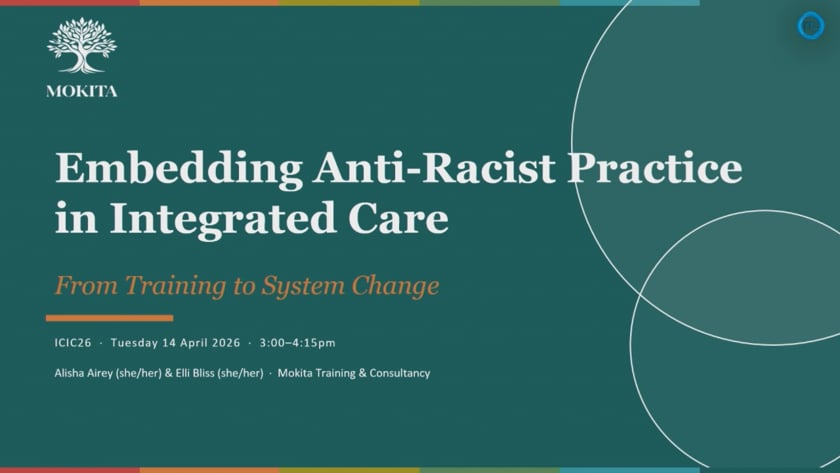
For us, that question sat at the heart of the session we delivered: Embedding Anti-Racist Practice in Integrated Care: From Training to System Change. But, if we're honest, what stayed with us most wasn't just the session itself. It was the conversations in between. The people we met. The shared understanding that things need to move beyond intention.
It's no longer about awareness
One thing felt really clear across the conference: we don't need more awareness. There's no shortage of people who understand that racism exists in health and care systems, that inequities shape outcomes and that staff experience matters.
What we heard, again and again, was something different. Organisations had done the training, gone through the process and ticked the boxes, and were now standing in that uncertain space wondering what comes next. Not because the commitment wasn't there, but because training, on its own, doesn't shift systems.
"We've done the training… so what now?"
That question, heard in corridors, in sessions and over lunch, is, we think, one of the most important questions the sector is asking right now. It signals a real maturity. People are ready to move past awareness. The challenge is knowing what to move towards.
The shift we're seeing
Across sessions, there was a noticeable change in the conversation. The questions people were asking had shifted. There was less 'do we acknowledge racism exists?' and more 'how does this show up in our policies, who is making decisions and who isn't, and what are we actually measuring?'
That shift matters enormously, because embedding anti-racism means moving it out of isolated training sessions and into workforce strategy, leadership accountability and service design. Not as an add-on, but as part of how organisations actually function day to day.
The organisations we found most compelling to talk to weren't necessarily the ones with the most polished approaches. They were the ones willing to look honestly at the gap between what they intended and what was actually happening.
Co-production came up a lot, and rightly so
Another theme that came through strongly was co-production and lived experience. And, honestly, it was encouraging to be in spaces where this wasn't just a buzzword, where people were having real conversations about bringing lived experience into decision-making, designing services with, rather than for, communities, and genuinely valuing different forms of expertise.
But there's something important to sit with here. Co-production isn't automatically equitable. Without an anti-racist lens, it can still reinforce existing power dynamics, become tokenistic, and miss the voices that most need to be heard. You can have all the right structures and still end up with the same people speaking and the same people being spoken about.
The question isn't just: are we co-producing? It's: who holds power in that space?
The importance of honesty
One of the most powerful parts of the conference, and our session, was the honesty: not having polished answers and not pretending this work is straightforward or that any organisation has fully figured it out.
There was real value in the spaces where people named the challenges, acknowledged the resistance, and were willing to talk about the emotional labour involved, for staff who experience racism, and for the leaders and colleagues trying to respond well. That's where real change starts: not in perfection, but in being willing to stay with the complexity rather than reach for a quick fix.
What happens next?
ICIC26 showed us that the commitment is there. Across organisations, roles and countries, people are genuinely trying to do this work better. And that matters.
But the next step is where it gets real: staying with it beyond the conference buzz, embedding it into systems rather than leaving it in conversations, and being willing to do the slower, less visible, more uncomfortable work that doesn't always produce a neat metric or a slide-ready outcome.
The organisations that will see lasting change are the ones that treat this as infrastructure, not an event: the ones that build capability internally, hold leadership accountable, and are honest with themselves when things aren't working.
A final reflection
We left ICIC26 feeling hopeful, not because the answers are clear, but because the questions are getting better. There is something genuinely meaningful happening in the sector, even when progress feels slow.
And one thing, for us, feels non-negotiable:
Anti-racism isn't a side project - It's a workforce issue. A leadership issue. A system issue.
The conversations are happening. The connections are there. Now it's about what we do with them.
Watch the full session recording here


Alisha Airey
Mokita Training & Consultancy

Elli Bliss
Mokita Training & Consultancy