CAREMATRIX
Pre-commercial procurement for integrated CARE solutions addressing the Multimorbidity mATRIX in ageing populations


CareMatrix was a European pre-commercial procurement (PCP) project running from 2021 to 2025 that set out to explore how digital solutions could better support integrated care for people living with multimorbidity. Rather than starting from a predefined technology or product, the project began with a shared challenge: how health and care systems can respond more effectively to the growing number of people living with multiple long-term conditions, within the realities of existing organisational, regulatory and workforce constraints.
Over the course of the project, CareMatrix worked with public healthcare organisations, researchers, policymakers and suppliers across Europe to translate this challenge into a structured innovation process. Through a staged PCP approach, the project defined system needs, engaged the market through open dialogue, and supported the co-development and validation of new solution concepts.
By its final phase, CareMatrix had resulted in the development and testing of two digital solutions — INCA, led by Doole Health, and HOPE-CMX, led by ADDI Medical AB. Both solutions were shaped through close collaboration with public buyers and grounded in real-world care contexts, addressing different but complementary aspects of multimorbidity, such as shared care planning, decision support, coordination across services, and patient involvement.
Beyond these solutions, CareMatrix also generated a wider body of results. These include a clearer articulation of system-level needs around multimorbidity, practical experience of using PCP as a tool for health innovation, and policy and implementation learning captured through collaboration with other European PCP projects. Together, these outcomes reflect not only what was developed through CareMatrix, but what was learned about designing, procuring and implementing digital support for integrated care.
IFIC’s Role: IFIC is leading the Dissemination and Communication WP7 and share the work of the project to its network of 30,000 people across Europe and the rest of the world. It also provides its annual conferences and the International Journal for Integrated Care as platforms for project partners to disseminate information about the progress, results and learning. We will also support the capacity building task activities in WP2 and WP3.
The Challenge
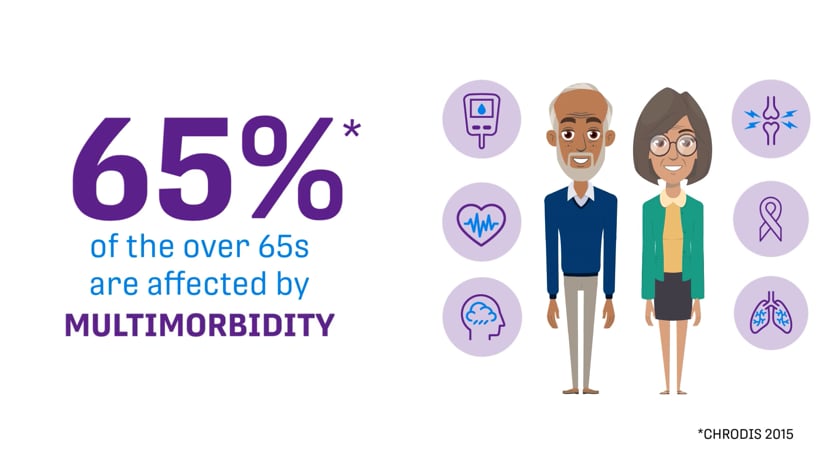
Multimorbidity concentrates many of the pressures facing health systems into a single population group: rising demand, workforce shortages, increasing costs, and growing expectations for care that is both personalised and coordinated. People with multimorbidity are more likely to experience unplanned admissions, longer hospital stays, and repeated interactions with different parts of the system.


Lisbeth Sommervoll, CEO of Vestre Viken HF in Norway, explains that the challenge lies not only in the clinical complexity of multimorbidity, but in the way care is organised.
“People now live with multiple long-term conditions. People are getting older. It’s an aging population and our health care system have traditionally been designed to treat single diseases one at a time. We can say that multimorbidity is a new normal, but our systems are still not designed for it to meet that need.”
For patients and families, this mismatch can make care harder to navigate and manage. For professionals, it creates inefficiencies and limits the ability to work proactively. For systems, it drives cost and sustainability challenges.
“This makes care much more complex for the patients themselves, their family, and for the system.”
CareMatrix framed integrated care not as an abstract ambition, but as a practical response to these realities. Supporting people with multimorbidity requires earlier identification, coordinated planning across disciplines, continuity over time, and meaningful involvement of patients and carers in managing their care.
“We have to stop thinking of just treating diseases and try to be more person-centred, coordinated, and proactive.”
The Solution
From the outset, CareMatrix grounded its work in the realities of implementation. Drawing on experience from health systems such as the Basque Country, Sweden, and Norway, the project examined how multimorbidity is currently managed — even in contexts with strong primary care and advanced digital infrastructure.

Iñaki Gutiérrez-Ibarluzea, Director of Health Research, Innovation and Evaluation at the Ministry of Health Basque Government, highlighted how a relatively small proportion of the population accounts for a disproportionate share of health system resources.
“What impress us it is that 25,000 inhabitants out of 2.2 million suppose one third of the budget, and 75,000 inhabitants out of 2.2 million inhabitants suppose half the budget. So it is concentrated in a minimum portion of the population, and most of those are multimorbid.”
Despite integrated electronic health records, care for people with multimorbidity often remains reactive and fragmented.
“There is no reconciliation of treatments. There is no professional figure that does it systematically, so we are treating single pathologies, but we are not treating the patient as a whole. Continuity. No one is taking care of the patient as a whole.”
Through engagement with professionals and system leaders, CareMatrix identified recurring gaps: late identification of people at risk, limited interdisciplinary collaboration, static care plans, poor continuity across settings, and insufficient support for patient and carer participation.
These insights informed the project’s use cases — not as fixed specifications, but as shared problem spaces where digital innovation could support more integrated ways of working in practice.

Rather than treating multimorbidity as a single problem to be solved, the project focused on identifying recurring pressure points where lack of coordination, late intervention, or fragmented information made care harder for patients and providers alike.
These insights were then translated into a set of use cases that reflected shared system challenges rather than technical specifications. The use cases were designed to act as reference points for dialogue — helping public buyers and suppliers explore what kinds of digital support might enable earlier identification, more coordinated care planning, better continuity across settings, and greater involvement of patients and carers. Importantly, they were intentionally framed to remain flexible and to evolve over time, allowing the project to test assumptions, incorporate feedback from the market, and adapt as implementation realities became clearer.
Across its phases, CareMatrix worked with a range of suppliers, each contributing learning at different stages of the PCP. These earlier engagements formed an important part of the project’s exploratory journey.
In the final phase, two suppliers — Doole Health and ADDI Medical AB — were selected to further develop and validate solutions shaped through the CareMatrix framing, use cases, and co-development process.
INCA

Developed by Doole Health, INCA is designed to support the management of multimorbidity through shared, individualised care planning. At its core is a digital care plan that brings together professionals from different disciplines, while also enabling patient involvement.
As Laura Martín Colet explained, the integrated care plan is the central organising element.
“The key here that we have already seen is having an integrated care plan.”
INCA supports early identification and prioritisation of people with multimorbidity, followed by structured assessment. It enables professionals to configure personalised care programmes, drawing on clinical information from electronic health records as well as patient-generated data.
“All the professional team that needs to be involved with a multimorbid patient can configure this care plan for the specific patient.”
To support decision-making in complex cases, INCA incorporates tools that surface relevant clinical guidelines and evidence tailored to individual patients.
“This is using artificial intelligence and helps professionals to receive some scientific papers and also clinical guidelines that are concrete for that specific patient.”
Implementation learning was a central theme in Laura’s reflections. INCA was developed with the recognition that digital tools must align with workflows and organisational change.
“A technological shift is not going to be possible without change management.”
The solution also explored alternative interaction channels to support people who may face digital literacy barriers, reflecting the realities of multimorbidity populations.
HOPE-CMX

Developed by ADDI Medical AB, HOPE-CMX approaches multimorbidity as a coordination and decision-support challenge that unfolds dynamically across conditions and care settings.
Nina Sellberg illustrated this perspective through the lived experience of patients.
“What Ken doesn’t experience is separate silos of his health.”
HOPE-CMX focuses on early risk identification and prioritisation, helping professionals identify patterns across conditions and act proactively.
The solution supports shared care plans that allow different professionals to view and act on relevant aspects of care, while maintaining a single, coherent overview of the patient.
“They don’t see the same problem in the same way. One size does not fit all.”
By supporting coordinated decision-making, HOPE-CMX aims to reduce duplication and enable more timely, holistic interventions.
“Instead of three separate meetings, we have one coordinated meeting.”
As with INCA, implementation learning featured strongly, including the need for endurance, collaboration, and adaptability across organisational boundaries.
“It’s so important to start from a concrete problem that actually exists across the organizational units.”
Testing and validation of the solutions
As part of the final phase of CareMatrix, both solutions were tested to assess their user-friendliness and suitability for people living with multimorbidity, as well as for health professionals and next of kin.
Given that both solutions introduced new functionalities beyond their previously approved indications, careful attention was paid to ethical and regulatory requirements. Test protocols were developed in line with EU guidance for clinical investigations of medical devices, and dialogue was held with medical product agencies and ethical review boards in all three participating countries. The testing was conducted following approval, with informed consent obtained from all participant groups.
In total, 150 participants took part in the testing across Norway, Sweden and Spain, including patients with two or more chronic conditions, clinicians, and next of kin. Testing was carried out in person at the test sites, with participants using the solutions in a stand-alone setting without integration into electronic health record systems. Participants completed structured tasks and then evaluated their experience using the System Usability Scale (SUS) alongside a project-specific questionnaire focused on functionality and task experience.
Both solutions achieved similar usability results, with only a small difference between their overall scores. In both cases, patients and clinicians rated usability lower than next of kin, and mean SUS scores fell below the standard benchmark of 68. At this stage of development, these results were considered positive, particularly given the complexity of multimorbidity, the absence of system integration, and the fact that some technical issues remained unresolved during testing. Language, digital literacy, and universal design factors were also identified as influencing user experience.
Qualitative feedback provided important insight beyond the numeric scores. Healthcare professionals consistently highlighted the need for better coordination across services and noted the potential efficiency gains of having relevant information available in a single system — while emphasising that meaningful impact would depend on close integration with existing electronic health records. Patients and next of kin placed particular value on improved communication, guidance, and continuity when interacting with multiple parts of the health system. Overall, most participants expressed a positive attitude towards using solutions of this kind in the future, reinforcing the relevance of the CareMatrix approach while also highlighting areas for further refinement and implementation learning.
Policy recommendations
CareMatrix’s experience also contributed to broader policy learning through 2CARE4EU, a collaboration between four European PCP projects. Drawing on experience across all phases of PCP, the initiative produced a set of policy recommendations grounded in real-world implementation.
The recommendations reflect challenges encountered during CareMatrix and similar projects, including:
Strengthening PCP governance and processes
PCPs require clearer, more supportive governance structures — including regulatory guidance, streamlined ethical and MDR processes, and reduced administrative burden — to enable smoother implementation for both procurers and suppliers.
Making PCPs more flexible and adaptive
Procurement models should better support iterative development, phased funding, and adaptability to emerging technologies, while remaining compliant with EU procurement rules and responsive to healthcare system realities.
Improving impact, monitoring, and alignment
PCPs should include stronger mechanisms to track long-term adoption, scalability, and economic impact, and be better aligned with broader EU health, data, and digital strategies to support integration and uptake.
Supporting sustainability and scale-up
To maximise impact, PCPs need timely post-project funding, stronger support for regulatory approval and clinical validation, and incentives for public–private co-financing to help successful innovations move from development to real-world implementation.
Conclusion and next steps
CareMatrix has shown that addressing multimorbidity requires more than new digital tools alone; it demands clearer problem framing, closer collaboration between public buyers and suppliers, and sustained attention to how solutions are developed, tested, and implemented within real health systems.
Through its use of pre-commercial procurement, CareMatrix created space to explore these challenges in a structured and transparent way, generating practical learning alongside tangible solution concepts.
Looking ahead, the next steps lie in building on what has been developed and learned. For health and care organisations, this means exploring how solutions such as INCA and HOPE-CMX could be adapted and implemented within local contexts, supported by appropriate integration with existing systems and workflows. For policymakers and programme designers, it means applying the lessons from CareMatrix and 2CARE4EU to strengthen future PCPs, particularly around early market engagement, regulatory alignment, and support for sustainability beyond project timelines.
More broadly, CareMatrix points to the importance of treating multimorbidity as a core organising challenge for integrated care, and of using procurement, policy, and practice in combination to support change at scale. The project’s outputs — from tested solutions to policy recommendations — provide a foundation for continued collaboration, experimentation, and learning as health systems across Europe seek more effective ways to support people living with complex, long-term conditions.
Project Partners


IFIC Staff

Fiona Lyne
International Foundation for Integrated Care (IFIC)


